

iPhone 17 Charging Speed Test: Apple’s latest flagship brings big changes to charging. The new lineup can charge up to 40W wired on some models. It can go from 0 to 50% in about 20 minutes. This is a big jump from before.
If you’re using a newer iPhone, upgrading to a MagSafe charger is one of the easiest ways to improve your daily charging routine. MagSafe technology uses built-in magnets to perfectly align your phone with the charger, giving you faster, more reliable wireless charging without the hassle of plugging in cables. 👉 View the Best MagSafe Chargers on Amazon. We’ve rounded up some of the top MagSafe-compatible chargers available—whether you’re looking for a budget-friendly option, a sleek desk stand, or a multi-device charger for your setup.
MagSafe has gotten a lot better, now supporting 25W. The Qi2 standard also jumped to 25W, a big step up from the old 7.5W. PhoneArena, a popular YouTube channel, tested these and confirmed the results. Is MagSafe Charging safe for iPhone battery life? Yes, it can actually help improve battery life. The Best iPhone Cases under $50 Dollars for drop protection.
Now, users have three ways to charge: traditional wired USB-C, MagSafe magnetic wireless, and standard Qi. Each has its own good points and downsides.
Choosing the best method depends on your lifestyle. Efficient wireless chargers are now good for daily use, not just for charging overnight. This guide looks at how each method performs in real life. It checks not just the fastest speeds but also how long it takes to charge the battery fully.
iPhone 17 Charging Speed Test Key Takeaways
- The flagship models support up to 40W wired fast charge, reaching half capacity in roughly 20 minutes.
- MagSafe magnetic technology now delivers 25W, making it genuinely practical for daily use.
- The Qi2 wireless standard provides 25W versus the previous 7.5W limitation
- The Air model supports 20W due to thermal management considerations
- Wired connections remain the fastest option, but wireless methods have closed the gap significantly
- Real-world testing reveals practical differences between advertised speeds and actual performance
Introduction to the iPhone 17 Charging Speed Test
For iPhone 17 users, picking the right charging method is key. It can mean the difference between staying connected and running out of battery. This test looks at three ways to charge the device, each with its own benefits.
The test focuses on real-world performance, not just what the makers say. Users need practical tips they can use right away. This analysis gives them that, through controlled tests and detailed measurements.
Why Power-Up Times Matter in Daily Life
Charging speed is now a must-have for smartphone users. The iPhone 17 is a vital tool for staying in touch, working, navigating, and enjoying entertainment all day. When the battery is low, every minute of charging is precious.
Think about those urgent moments we all face. Running late for the airport with a dead battery is stressful. A short break can be enough for a quick charge. Seeing the battery at 5% before a big call is worrisome.
Fast charging solves these worries. It lets users use their devices without worrying about charging. Less downtime means more productivity and peace of mind all day.
The Three Methods Explained
The iPhone 17 has three charging options, each for different needs. Knowing these helps users manage their power better.
Wired charging is the fastest when time is of the essence. It uses USB-C cables and adapters for a direct connection. This method transfers power efficiently, wasting little as heat.
MagSafe charging offers wireless power with magnetic alignment. It ensures the iPhone 17 charges perfectly on the pad. It’s great for those who value ease and decent speed.
Standard Qi wireless charging works with many devices, not just Apple’s. Its universal appeal is a big plus for mixed households. It’s come a long way from its early days.
The leap from 7.5W to 25W in Qi wireless charging is huge. It makes wireless charging practical for more than just overnight charging. Now, users can get 0-50% in about 30 minutes with the right adapters.
Choosing the right charger and cable is key to fast charging. Without the right match, charging is much slower than expected.
Each charging method has its own balance of speed, convenience, and compatibility. Wired is all about speed. MagSafe offers wireless ease with good performance. Traditional wireless focuses on universal use and simplicity.
This basic understanding sets the stage for the detailed test results that follow. The next sections show how each method performs in real tests. With this info, iPhone 17 owners can choose the best charging strategy for their needs.
Wired Charging for the iPhone 17
Wired charging is the fastest way to charge Apple’s latest iPhone 17 lineup. Using a USB-C cable gives the quickest results. This method beats wireless charging when speed is key.
The iPhone 17 Pro and Pro Max can charge up to 40W. This is a big jump from before. With the right adapter, they can get to 50% in about 20 minutes. This is great for quick power-ups during busy times.
The iPhone 17 Air has a different design. It supports up to 20W charging. Users can expect a 0-50% charge in about 30 minutes with a compatible adapter.
Real Performance Numbers
Tests show the Pro models can charge at 35-36W. This is real performance users see every day. A full charge takes 60 to 75 minutes.
Adaptive fast chargers can charge devices to 70% in 30 minutes. But the speed slows down after that.
Apple’s charging tech adjusts speed based on battery level. The first 50% charges fast. Then, the speed stays strong but slows a bit.
Charging slows significantly after 70-80%. The last 20% can take up to 45 minutes. This slowdown helps protect the battery from heat and stress.
Maximizing Wired Performance
For the best charging speed, you need good equipment and smart practices. The charger and cable are key. Cheap, low-quality accessories can slow down charging and be unsafe.
Apple’s 40W Dynamic Power Adapter works great with the iPhone 17 Pro. But you don’t have to buy Apple’s stuff. Good third-party brands offer the same quality at lower prices.
Key requirements for optimal wired charging include:
- A USB-C Power Delivery adapter rated at 40W or higher for Pro models
- A quality USB-C to USB-C cable from certified manufacturers
- Proper ventilation around the device during charging sessions
- Avoiding intensive app usage while charging when possible
Low-quality cables can damage your device or be unsafe. Spending on good accessories ensures you get the fast charging you need.
Apple’s AVS technology manages power delivery during charging. It balances speed and battery life by adjusting voltage and current as needed. Temperature, battery age, and charge level affect how it works.
The iPhone 17 charges 30% faster than the iPhone 16. Going from 27W to 40W means more time using your phone for every minute plugged in. This is a big plus for busy people.
Charging in cool, well-ventilated areas helps avoid heat issues. Taking off thick cases also helps with heat dissipation.
Wired charging works well even when you’re using your phone a lot. You can game, video call, or stream while charging without losing speed. This makes wired charging the best choice when you need both speed and function.
MagSafe Charging Capabilities
Apple’s MagSafe system makes wireless charging fast and easy for iPhone 17 users. It fixes the problem of charging pads not lining up correctly. Plus, it charges as fast as a cable.
MagSafe is great for those who want convenience and speed. It’s a smart choice for anyone who values both.
Magnetic Alignment Meets Modern Power Delivery
MagSafe uses magnets to align your phone with charging pads. This ensures the best power transfer every time. It’s different from old wireless chargers that needed perfect placement.
The tech uses the Qi2 25W standard, which is much faster than the old 7.5W. It can charge up to 25W, faster than the old 15W MagSafe. This makes charging more efficient and standard across devices.
To charge fast, you need a 30W power adapter with your MagSafe pad. It starts with a quick 29W burst, then settles at 25W. This keeps the phone cool and charges it well.
Advantages and Limitations Worth Considering
MagSafe has many benefits but also some downsides. It’s important to know both before getting into it.
Key advantages of MagSafe charging include:
- Cable-free convenience with a simple drop-and-go operation that saves time
- Perfect alignment guaranteed every time through magnetic guidance
- Ability to use the phone while charging with compatible stands and mounts
- Reduced wear on charging ports from constant plug-unplug cycles
- Growing ecosystem of accessories, including car mounts, desk stands, and power banks
Notable limitations to keep in mind:
- Slightly slower charging speed compared to wired connections
- Higher cost for MagSafe-certified accessories versus standard chargers
- Potential interference from thick cases or metal attachments
- Slightly more heat generation than traditional cable charging
MagSafe is great for desk stands that angle your phone. It’s perfect for video calls or StandBy mode. This is something old wireless pads can’t do.
Real-World Performance Data
Tests show the iPhone 17 charges to 50% in about 30 minutes with MagSafe. This is just 10 minutes slower than wired charging for the first half. A full charge takes 90-110 minutes, depending on use.
During charging, MagSafe manages power well. It briefly goes to 29W then stays at 25W. This keeps the phone cool and charges it efficiently.
The iPhone 17 Air charges up to 20W with MagSafe. It charges to 50% in 30-35 minutes. A full charge takes 100-120 minutes. This small difference doesn’t affect daily use much.
MagSafe is a big leap from old wireless standards. It’s now good for quick charges during the day. If you’re experiencing slow charging or excessive heat, try removing your case.
MagSafe is the best of both worlds for many users. It’s perfect for daily use, like charging at your desk or in your car.
Wireless Charging Performance
The iPhone 17 supports universal wireless charging standards. This means you can use many different accessories. It’s great for people who have lots of gadgets.
These standards work across brands and devices. This makes them very versatile. Knowing how they work helps you pick the best charging solution for you.
How Wireless Technology Powers Your Device
Wireless charging uses electromagnetic induction. The charger creates a magnetic field. This field makes the iPhone’s coil generate electricity, all without a cable.
Hundreds of manufacturers use the Qi standard for wireless charging. It’s found in furniture, cars, and public places all over. The iPhone 17 supports both the older Qi standard and the newer Qi2 specification.
Qi2 is the latest from the Wireless Power Consortium. It can charge at up to 25W, which is faster than the old 15W. It also makes sure the phone is in the right spot for optimal charging.
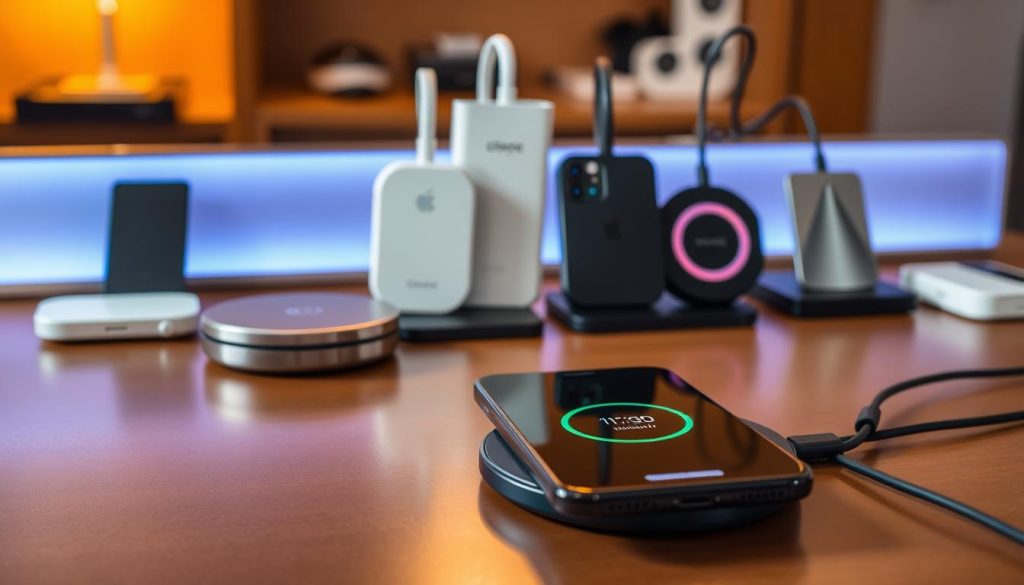
Qi2 is more efficient, which means less waste heat. Heat has always been a big problem for wireless charging. Choosing the right charger is important.
What Impacts Your Charging Speed
Several things affect how fast your iPhone 17 charges wirelessly. Knowing these helps you get the best charge. The speed test results vary significantly based on these factors.
Power adapter wattage is key to charging speed. The charger needs enough power from the wall. Usually, a 30W input is needed to get 25W to the device.
Things that affect charging speed include:
- Alignment precision – A little misalignment can cut power transfer by half or more
- Case thickness and materials – Thin cases are okay, but thick ones block the charge
- Ambient temperature – Heat makes the phone slow down charging to stay cool
- Metal attachments – Things like credit cards or magnets can cause heat buildup
- Charger quality – Good Qi2 chargers work better than cheap ones
Wireless charging can make the phone warmer than wired charging. Apple’s iPhone 17 keeps the temperature safe. It might slow down charging if it gets too hot.
Wireless charging is about 70-80% efficient, while wired is 90-95%. This difference in efficiency means more heat. Apple’s system checks the temperature and adjusts charging to keep it safe.
Many users charge their phones with their case on. But if charging is slow or the phone is warm, try removing the case. This simple step often fixes the problem.
Here are some tips for better wireless charging:
- Take off thick cases before charging
- Charge in cool places with good air flow
- Make sure the phone is perfectly aligned on non-magnetic pads
- Use quality Qi2-certified chargers
- Avoid charging in direct sunlight or hot cars
Wireless charging is slower and warmer than wired charging. But it’s worth it when you don’t want to deal with cables.
Desk and nightstand charging are great uses for wireless. They make it easy to check notifications or charge before bed. These situations value convenience over speed.
Cold places can also affect charging efficiency. But this is true for all charging methods. The key is to understand how wireless charging works under different conditions.
Comparing the Charging Speeds
iPhone 17 users now face a charging landscape where the performance gap between methods has narrowed dramatically. The evolution of wireless charging technology means that choosing a charging method isn’t just about raw speed anymore. It’s about understanding which option fits specific daily routines and usage patterns.
This iPhone 17 Charging Speed Test provides data to help users make informed decisions. The numbers tell a compelling story about how far wireless charging has come. More importantly, they show when those extra minutes actually matter in real-world use.
Head-to-Head Performance Analysis
The battle between wired and MagSafe charging reveals surprisingly competitive results. Wired charging reaches 0-50% battery in approximately 20 minutes using the 40W power adapter. MagSafe technology achieves the same milestone in roughly 30 minutes with its 25W capability.
That 10-minute difference represents a significant improvement over previous iPhone generations. For most users, this gap has become small enough that convenience often outweighs pure speed. The charging technology has advanced to the point that MagSafe offers genuinely practical performance for everyday use.
Full charge times show a wider but manageable gap. Wired fast charging completes a full cycle in 60-75 minutes from a completely drained battery. MagSafe takes 90-110 minutes for the same task, creating a 15-35 minute difference.
Here’s how the charging methods compare at regular intervals:
- 15 minutes: Wired delivers 35% charge, MagSafe provides 25%
- 30 minutes: Wired reaches 70% charge, MagSafe hits 50%
- 60 minutes: Wired approaches 100%, MagSafe achieves 75%
- 90-110 minutes: Both methods reach full charge
Energy efficiency tells another important part of the story. Wired charging operates at approximately 90-95% efficiency, meaning very little power gets wasted. Wireless charging achieves 70-80% efficiency, with more energy converting to heat.
This efficiency difference impacts battery temperature during charging sessions. Lower temperatures during the charging process contribute to better long-term battery health. Apple’s thermal management systems ensure all methods remain safe for the device.
The Speed Champion and Practical Reality
Standard Qi wireless charging lags significantly behind both premium options. Chargers operating at 7.5W require approximately 3-4 hours for a complete charge cycle. Even 15W wireless chargers need 2-3 hours to finish the job.
Wired charging remains the undisputed speed champion in any tech review. But asking “which is faster?” misses the point. The real question is: “Which is fast enough for my lifestyle?”
Consider these real-world scenarios that illustrate practical differences:
- Emergency top-up before leaving home with 10% battery remaining and 15 minutes available: wired delivers 35-40% (several hours of use), while MagSafe provides 25-30%
- Charging overnight for 7-8 hours: both methods easily reach 100% with no practical difference in outcome
- Midday desk charging during a 2-hour work session: both methods provide substantial charge restoration
Battery degradation differences between methods prove minimal over typical ownership periods. Users keeping their iPhone 17 for 2-3 years will see negligible differences in battery health. The sophisticated thermal controls protect the battery regardless of the selected charging method.
The charging comparison reveals that choosing between methods isn’t about declaring an absolute winner. Understanding which method best fits different scenarios creates the optimal charging experience. Many iPhone 17 owners benefit from having both wired and MagSafe options available.
For situations demanding every possible minute of charge time, wired connections deliver unmatched performance. When 10 extra minutes won’t disrupt daily routines, MagSafe offers comparable practical results with superior convenience. The narrowed performance gap means users can prioritize convenience more than ever before.
This evolution in charging technology empowers users with genuine choices. The days of sacrificing significant speed for wireless convenience have largely ended. Modern iPhone 17 Charging Speed Test results confirm that wireless charging has matured into a practical primary charging solution.
Real-World Charging Scenarios
Every iPhone 17 owner wonders which charging method to use many times a day. The choice depends on the situation. Knowing when each method is best helps users make smart choices that fit their lifestyle and needs.
The best charging method changes throughout the day. What’s perfect for charging overnight might not work in the morning rush. Understanding these patterns makes technical specs useful in real life.
Everyday Charging Patterns
Wired charging is best when every minute counts. For example, finding an uncharged iPhone 17 at 7 AM means you need fast charging to get through the day.
Business people preparing for flights or meetings benefit from wired charging. Charging while packing or reviewing documents saves time. A 20-minute window can give 50% battery with fast charging.
MagSafe charging is great for work-from-home days. It keeps your iPhone 17 charged on a desk stand while you’re on calls. This makes checking notifications easy without interrupting charging.
“The wireless charging pad on my nightstand changed everything. I just drop my iPhone before bed and wake up to 100% every morning without fumbling with cables in the dark.”
Nightstand charging is MagSafe’s most popular use. It charges automatically, even without looking. The slower speed doesn’t matter during eight hours of sleep.
Standard Qi wireless charging is good for shared spaces and cars. It works for all devices and keeps cars clutter-free during drives.
When Speed Becomes Critical
Some situations need the fastest charging. Realizing your iPhone 17 is at 15% battery 30 minutes before leaving for the airport is stressful.
Fast charging is key in these moments:
- Quick charges between video meetings when battery drain is heavy
- Emergencies needing important calls or navigation
- Outdoor activities need maximum charge before leaving
- Running late scenarios where an extra 10 minutes of charging are critical
Parents rushing kids to school while getting ready for work presentations feel this pressure. Those 15 minutes at home are precious for charging.
On the other hand, some situations don’t need fast charging. Overnight charging gives enough power for the day. Small charges throughout the day add up without needing to recover from empty.
Weekends at home rarely need urgent charging. Users have time to charge without feeling rushed.
Choose wired charging when: You need the fastest charge, like when you’re running late. Wired charging is efficient for power-intensive apps and short charging windows.
Choose wireless charging when: Convenience is more important than speed. Wireless charging is great for everyday use, such as charging on a desk or nightstand. It’s easy to grab your phone without unplugging.
Digital nomads and travelers often prefer compact wired chargers that work with any outlet. Tech enthusiasts use both methods in different places.
Remote workers charge their phones on desk stands without effort. Commuters charge wirelessly during drives. Travelers carry 40-watt adapters for fast charging in hotel rooms.
The smartest approach combines both technologies. Keep wired charging for emergencies and use wireless for daily convenience. This way, you’re not limited to one method.
This dual-method strategy prevents users from limiting themselves. The iPhone 17 supports multiple charging technologies for different situations. Having quality accessories for both wired and wireless charging makes life more flexible.
Accessories That Enhance Charging
Getting the right charging accessories is key for iPhone 17 users. The right mix of chargers, cables, and accessories can make a big difference. Quality gear means faster charging and better battery health over time.
Not all charging accessories are created equal. Cheap options might promise fast charging, but often don’t deliver. Trustworthy brands offer reliable performance that matches the iPhone 17’s capabilities.
Power Adapters for Maximum Performance
Apple’s 40W Dynamic Power Adapter works great with the iPhone 17. But you don’t have to spend a lot on official Apple products. Good USB-C PD chargers from other brands can offer similar results at a lower price.
Brands like Anker, Belkin, and Ugreen offer great chargers for $25 to $35. They use the same USB-C Power Delivery protocols for fast charging. As long as the adapter is from a reputable brand, you’ll get the best speeds.
What makes a charger stand out? GaN technology makes chargers smaller and more efficient. Foldable prongs and multiple USB-C ports add convenience.
Cable quality is just as important as the adapter. Look for USB-C to USB-C cables that support Power Delivery and handle 40W charging. Choose cables with E-Marker chips and braided designs for durability.
Shorter cables are better for charging at your desk or bedside. Longer cables offer more flexibility for charging from a distance.
MagSafe Solutions for Wireless Convenience
Certified MagSafe chargers ensure 25W charging and proper alignment for the iPhone 17. Non-certified chargers might look similar but charge more slowly. Always choose certified chargers for fast charging.
MagSafe-compatible power banks offer 25W charging anywhere. They attach securely to your phone, allowing you to use it while charging. These power banks can charge your phone multiple times before needing to recharge themselves.
These power banks are perfect for travel or busy days. They come with integrated cables that double as carrying straps. This makes wireless charging easy and convenient on the go.
Desktop MagSafe stands offer adjustable angles for video calls or monitoring notifications. Angled stand chargers keep your iPhone 17 at the perfect viewing angle for StandBy mode. This turns your phone into a smart display while it charges.
Car mount chargers with MagSafe charging solve the problem of phones dying during drives. They hold your phone securely and charge it automatically, even during sharp turns. You can attach them to your vent or dashboard.
Multi-device charging stations are great for Apple ecosystem users. They clear clutter and charge your iPhone 17, AirPods, and Apple Watch at 25W. These stations offer a compact solution for charging your entire ecosystem.
Premium materials and design make these stations stand out. They have proper spacing to prevent heat transfer and adjustable angles for different uses. This ensures your devices charge safely and efficiently.
Planning your budget helps you get the right charging accessories. A basic setup with a 40W adapter and cable costs $30 to $40. Adding a MagSafe stand costs $80 to $120. A full setup with chargers, power banks, and car chargers costs $150 to $200.
Investing in quality charging accessories saves time and frustration. It also extends your device’s life. With the right accessories, you’ll always have a charging solution wherever you are.
Battery Health and Charging Speed
Many iPhone 17 owners wonder if fast charging harms their battery. But the truth is more complex. Apple has created technology to protect your battery’s life. This tech ensures you can charge quickly without worrying about damage.
Lithium-ion batteries naturally wear out over time. Each full charge cycle slightly reduces their capacity. Yet, fast charging isn’t inherently bad if managed correctly, which the iPhone 17 does.
Understanding Fast Charging and Battery Longevity
The iPhone 17 uses AVS (Adjustable Voltage Supply) technology. It smartly controls power delivery during charging. This balance ensures your phone performs well without harming the battery.
Charging isn’t a straight line. The iPhone charges quickly from 0% to 50%. It then slows down to protect the battery during the last 20%.
This three-stage approach is key to managing battery chemistry:
- 0-50% range: Maximum power delivery when the battery safely accepts rapid charging
- 50-80% range: Moderate charging speed to reduce stress and heat generation
- 80-100% range: Slow charging that minimizes stress at extreme charge states
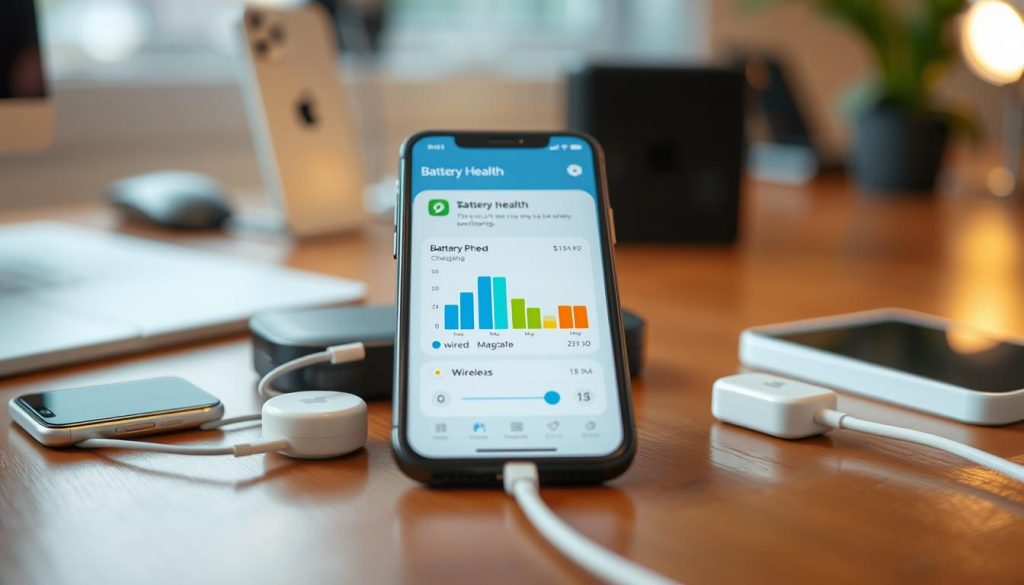
Heat is the main enemy of battery life. High temperatures during charging speed up degradation. This is why the iPhone 17’s wireless charging is more cautious.
Wireless charging gets hotter because it’s less efficient. The iPhone 17’s system continuously checks the battery temperature. If it gets too hot, it slows down charging to prevent damage.
Apple’s system keeps temperatures safe, even if it means slower charging. This ensures that fast charging doesn’t damage your battery as much as slow charging.
iOS 18’s Optimized Battery Charging feature takes it further. It learns your charging habits and pauses at 80% if you’ll be plugged in for a while. It then finishes the last 20% just before you unplug in the morning.
This smart feature reduces battery stress. It makes your iPhone 17 last longer and perform better.
Practical Tips for Maintaining Battery Health
There are simple ways to keep your iPhone 17’s battery healthy. These steps work with Apple’s built-in protections to ensure your phone lasts longer.
Essential battery health practices include:
- Enable Optimized Battery Charging in Settings > Battery > Battery Health
- Avoid extreme temperatures during charging sessions
- Remove thick cases during fast charging to improve heat dissipation
- Don’t routinely run the battery to 0% before charging
- Understand that gradual degradation is normal
Lithium-ion batteries prefer partial discharge cycles. Charging from 40% to 80% multiple times a day is better than full drains.
Never charge your iPhone in direct sunlight or hot cars. High temperatures and charging heat are bad for your battery. Charging in freezing conditions can also temporarily lower performance.
Recent iOS versions let you limit charging to 80%. Some users do this to extend battery life. But it’s not necessary for most people.
Battery wear means an 85-90% capacity after 2-3 years of normal use. This is normal, not a cause for concern. If your battery degrades too much, replacing it is a cost-effective option.
Don’t worry about fast charging harming your battery. Apple designed the iPhone 17’s charging systems to balance speed and longevity. Fast charging is convenient and safe for your battery.
Knowing that speed and longevity can coexist helps you charge without worry. Apple’s system automatically balances these needs. You can choose your charging method without concern.
User Experiences and Reviews
People who use the iPhone 17 have shared their experiences. They talk about charging on YouTube, Apple forums, and social media. Their stories help others know what to expect.
Many tests show Apple’s charging speeds are real. People love the fast charging, but also share their concerns. This gives a full picture of what it’s like to use the iPhone 17 every day.
Real Voices from Early Users
PhoneArena tested the iPhone 17’s charging on YouTube. They used a 40W charger and checked Apple’s claims. They found the charging speed to be around 35-36W.
Comments on tech videos show users are excited. They like how wireless charging is faster. This change is big for many.
Some users got fast chargers that work well. They charged their phones to 70% in 30 minutes. This matches what Apple said.
Apple forums show different charging needs. Commuters like car mounts for on-the-go charging. Parents like the safety of wireless charging.
Business users like angled stands for their phones. They keep the phone visible and charged during meetings. This is a big plus for them.
Work-from-home folks love MagSafe desk stands. They keep devices charged and look good. This is a big win for them.
Users noticed that charging speeds slow down at 70-80%. This is because Apple wants to protect the battery. People now see it as a good thing.
Troubleshooting Common Problems
Even with positive experiences, some users face charging issues. Knowing how to fix these problems helps. Most fixes are easy and don’t need tech skills.
- Many “not charging” problems are due to loose connections. Try reseating the cables and using different outlets. This usually fixes it.
- Debris in the charging port can also block charging. Clean it with a toothpick or compressed air. This simple step can solve many problems.
- “Slow charging” issues often come from old chargers. Using a 40W+ adapter makes a big difference. This is a quick fix.
- Using non-certified cables can slow down charging. Stick to MFi-certified accessories for the best results. Good accessories are worth it.
- Some users get warnings about non-certified accessories. This is to protect your phone. Always use certified products.
- Wireless charging problems can be due to alignment issues. Make sure your charger and phone are aligned properly. This avoids problems.
- Foreign objects between the phone and charger can also cause issues. Make sure nothing is in the way. This solves the problem.
Some users worry about their phone getting warm. This is normal. Improving airflow and avoiding direct sunlight helps.
Concerns about battery health are common. Apple’s systems protect the battery. A drop in battery health is normal and not a problem.
Users have different preferences for charging. Some like wireless for its convenience. Others prefer wired for speed. It depends on what you need.
Heavy users need faster charging more. Light users might prefer convenience over speed. It varies based on how you use your phone.
This summary of user feedback helps others know what to expect. Real experiences often match or beat what’s advertised. The stories from early users are very helpful.
Future of Charging Technologies
Charging tech never stops getting better. The next big thing in smartphones is already being worked on in labs and factories around the world. The iPhone 17 shows us what’s possible today, but tomorrow’s tech will change how we charge our phones.
The move to USB-C on all iPhone 17 models is more than just a new connector. It’s Apple’s way of making things easier for everyone. This change helps reduce waste and makes it easier to use different devices together.
With USB-C, you can charge many devices with the same cables. This is great for phones, laptops, tablets, and even cameras. Learning how to use these new charging options can make your life easier, just like learning new iPhone camera tips can improve your photography.
Predictions for iPhone Charging Innovations
Wireless charging is getting a big boost soon. We might see wireless charging as fast as wired charging in just a few years. This means MagSafe could become as quick as plugging in a charger.
The Qi standard is getting better, too. Soon, we’ll see faster and more efficient wireless charging. Apple is helping make this happen, so future iPhones will charge faster and work with older chargers.
New battery tech is also on the horizon. Solid-state batteries could make phones last longer and charge faster. They’re safer, too, which is a big plus.
- Higher energy density for longer battery life
- Faster charging capabilities beyond current limits
- An extended lifespan with less wear and tear
- Improved safety profiles to avoid overheating
If Apple uses solid-state batteries, phones could charge even faster. This means less worry about running out of power and bigger batteries for longer use.
Future iPhones might also learn to charge more efficiently based on how you use them. This could make charging faster and more efficient without doing anything extra.
“The future of smartphone charging isn’t just about speed—it’s about creating intelligent systems that understand user needs and adapt to them while extending device lifespan and reducing environmental impact.”
Wireless charging of other devices might be coming to iPhones soon. This feature is already in some Android phones and could make Apple devices even more useful.
Trends in Smartphone Charging Speeds
Apple’s 40W charging is a big step up, but some Android phones can charge even faster. These phones can go from 0 to 100% in under 20 minutes. But these speeds might not be as good for the battery in the long run.
These fast charging speeds can also make phones hotter. This could affect how well other parts of the phone work. And, these phones often use special charging systems that might not work with other accessories.
Apple is taking a more careful approach. They want to make sure phones charge fast but also last a long time. They’re focusing on making charging better for everyday use, not just for fast charging.
Here’s what we might see in future iPhones:
- 60W+ wired charging will become standard in a few years
- 40W+ wireless charging is getting as fast as wired
- Larger battery capacities through new chemistry and design
- Enhanced charging management using AI
- Universal compatibility with more accessories
Charging tech is also getting greener. Companies are working to make less waste and use less energy. This includes using recycled materials and making chargers last longer.
Apple’s decision not to include chargers with iPhones is part of this trend. It’s making the world a little bit cleaner. We might see more chargers made from recycled materials and designed to be fixed rather than thrown away.
Long-range wireless charging is a big dream for the future. It would let you charge your phone from across the room. It’s a cool idea, but it’s not easy to make it work without losing too much power.
It’s hard to say exactly what future iPhones will be like. But we can expect them to charge faster, last longer, and be better for the planet. The choices we make today will shape the tech we use tomorrow.
The iPhone 17’s charging features are great today, but tomorrow’s tech will be even better. We’ll see faster charging, longer battery life, and more ways to charge your phone. Apple is always working to make things better for its users.
Conclusion: Optimal Charging for Every User
The iPhone 17 Charging Speed Test shows big improvements. It makes charging easier every day. Now, users have more choices between wired and wireless options.
Summary of Key Findings
Wired charging at 40W is the fastest, reaching 50% in about 20 minutes. MagSafe wireless charging at 25W is now a good daily choice. It also hits 50% in 30 minutes.
This 10-minute difference makes wireless charging great for the day. It’s not just for charging at night anymore.
Standard Qi wireless charging is slower but good for overnight charging. The iPhone 17 Air’s 20W speed is impressive, even with its thin design.
Final Recommendations for iPhone 17 Users
For those who want speed, get a 40W USB-C charger. If you prefer convenience, use MagSafe stands at your desk or nightstand. Most people find it best to have both options.
Choose the right method for the situation. Use wired charging in the morning or before you leave. Wireless charging is perfect for work hours and charging at night.
Good accessories are key. Start with a 40W wall charger and a MagSafe stand, costing about $70-100. This setup lets you use the iPhone 17 to its fullest. By using both methods, you get the best results and meet your charging needs.