

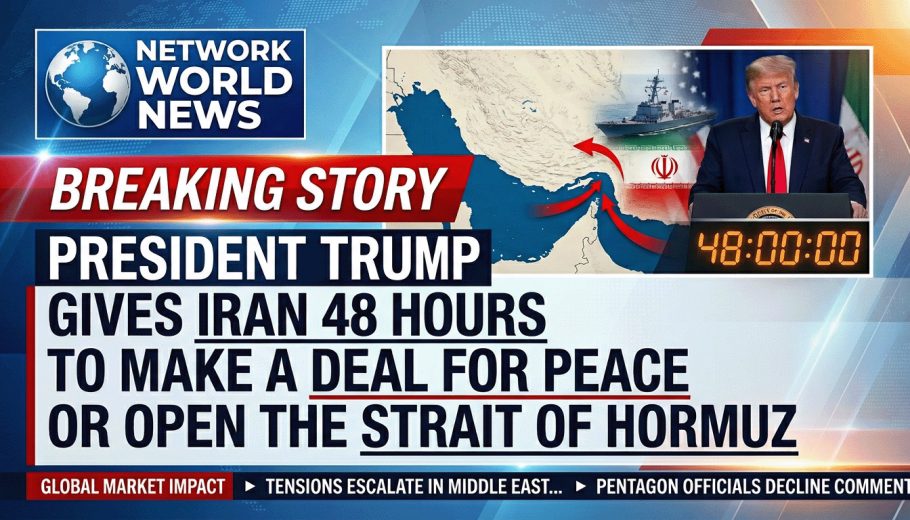
For U.S. readers watching gas prices and global risk, the Iran deadline is now measured in hours, not weeks. President Donald Trump said Saturday that Iran must either reopen the Strait of Hormuz or agree to peace. Or face new U.S. strikes aimed at Iran’s energy infrastructure. The Iran conflict is now in its 6th week. Iran does not seem to be cooperating with Trump.
In a Truth Social post, Trump wrote: “Remember when I gave Iran ten days to MAKE A DEAL or OPEN UP THE HORMUZ STRAIT… Time is running out — 48 hours before all Hell will reign down on them. Glory be to GOD!” The Iran deadline news sets a clear clock: Monday, April 6, at 8 p.m. Eastern, after repeated extensions as back-channel contacts continued.
The practical stakes are hard to miss. The Strait of Hormuz is a critical shipping lane for oil and gas. Iran effectively shut it down after being bombed by the U.S. and Israel. That disruption helped push prices higher worldwide, turning a distant waterway into a direct concern for American households.
That is why the Iran deal deadline is landing with extra force. Trump is betting that the threat of economic pain and targeted strikes can force a reversal. Trump speaks to the nation on the Iran war.
Iran is signaling the opposite: defiance, readiness, and a willingness to escalate if pressed. With the Iran negotiations deadline set and public warnings rising on both sides, the next two days could reshape the region and the global energy market.
Key Takeaways
- The Iran deadline gives Iran 48 hours to reopen the Strait of Hormuz or reach a peace agreement.
- Trump set the final cutoff for Monday, April 6, at 8 p.m. Eastern time.
- Trump warned of renewed strikes targeting Iran’s energy infrastructure if Iran refuses.
- Iran’s shutdown of the Strait of Hormuz has fueled spikes in global oil prices.
- The Iran deadline news is driving new urgency in diplomacy and military planning.
- The Iran deal deadline highlights competing narratives: coercive leverage versus open defiance.
What Trump’s 48-Hour Ultimatum Means for the Strait of Hormuz and Global Energy Markets
News spread quickly as the Iran deadline became clear. Traders watched shipping routes closely. The Iran deadline update focused on one narrow waterway and its impact on fuel costs and delivery times.
In the United States, the focus is on the effects, not just words. A threat near a major chokepoint can quickly change tanker schedules and insurance prices.
Trump’s Truth Social warning and the April 6 cutoff
On Saturday morning, Donald Trump posted on Truth Social. He warned of a 48-hour countdown to April 6. His message included “48 hours before all Hell will reign down on them” and “Glory be to GOD!”
He set the cutoff for April 6 at 8 p.m. Eastern time. This timing is important because markets price risk around clear clocks, not vague threats.
How the deadline traces back to March threats targeting Iran’s energy infrastructure
The Iran talks deadline has roots in a March 21 post. Trump threatened to “hit and obliterate” Iranian “POWER PLANTS” if Iran didn’t open the strait.
He had used a shorter two-day timeframe last month, then extended it several times. The final cutoff is now April 6. The consequence for missing the deadline is military strikes on Iran’s energy infrastructure.
Why the Strait of Hormuz matters: about one-fifth of the world’s oil and natural gas flows
The Strait of Hormuz is a critical energy route. About 20% of global oil shipments pass through it, and it carries about one-fifth of the world’s natural gas.
At its narrowest point, the strait is about 21 miles wide. Shipping lanes are only 2 miles wide in each direction. Even limited military action could close the chokepoint, affecting energy markets and trade routes.
- Delays can push up shipping insurance premiums and force costly rerouting.
- Tighter supply can ripple into transportation and manufacturing within days.
- Strategic Petroleum Reserve deployment limits can constrain how fast supply gaps are filled.
Oil and gas price pressure: restrictions after U.S.-Israel strikes and the spike at the pump
Restrictions on the channel were put in place after U.S. and Israeli strikes on Iran in late February. Global fuel prices climbed. AAA reported gas at $4.10 on Saturday, about $1.10 higher than last month, as the Iran deadline update kept nerves elevated.
Administration messaging has downplayed concern about rising prices. Trump predicted the economy would “bounce back fast” after the conflict ends. He suggested the strait would “open naturally” soon after, even as the Iran deadline latest continued to shape trading, freight planning, and near-term price expectations.
Iran Deadline: Latest developments in U.S.-Iran pressure, military risk, and diplomacy
The latest on the Iran deadline is complex. It involves public threats and private efforts to negotiate. Both sides are trying to show strength and flexibility in their talks.
Iran’s mixed response: “locked, loaded” rhetoric and warnings of broader, more destructive attacks
Iran is sending mixed signals. On one hand, they say they are ready for action. On the other hand, they warn of more severe attacks.
President Masoud Pezeshkian wrote a letter to the American people. He warned that attacks on Iran’s power grid could be a war crime. He said this could lead to instability and economic problems worldwide.
Escalation backdrop: reports of two U.S. jets downed and the ongoing search for a missing pilot
Things got worse when Iran shot down two U.S. fighter jets. One pilot was found, but the other is missing. This has raised the stakes in the conflict.
Donald Trump said the search for the missing pilot is almost over. He also threatened to make Iran very weak. The U.S. has attacked a major bridge near Tehran, and Trump has threatened more attacks.
Trump believes the conflict will end in a few weeks. But the U.S. has been at war for over a month. This makes the deadline for talks uncertain.
U.S. political messaging: Sen. Lindsey Graham backs “overwhelming military force” if Iran refuses
On Capitol Hill, politicians are also weighing in. Sen. Lindsey Graham supports using strong military force if Iran doesn’t agree to talks. He told Trump to be careful.
Democrats want more information about the strikes. They are also fighting over presidential war powers. This debate affects the chances of successful talks with Iran, as reported in the Senate war powers resolution.
Parallel pressure track: Rubio revokes green cards tied to Soleimani’s relatives amid a wider crackdown
There’s also a domestic push against Iran. Secretary of State Marco Rubio has revoked green cards for relatives of Qasem Soleimani. This includes his niece, Hamideh Soleimani Afshar, and her daughter.
Rubio said Afshar promoted Iranian regime propaganda while in the U.S. She celebrated attacks on American soldiers and supported the Islamic Revolutionary Guard Corps. Rubio said she lived a lavish lifestyle in Los Angeles and posted on Instagram before it was deleted.
Acting Assistant Homeland Security Director Lauren Bis explained how Afshar and her daughter entered the U.S. They traveled in 2015, and Afshar later made trips to Iran. Bis said this undermines her asylum claims and that green cards can be taken away if someone is seen as a threat.
This move is part of a broader crackdown on immigration. It includes paused visa processing and a closer look at green card eligibility for people from countries like Iran. This adds to the pressure on Iran to agree to a ceasefire deal, as reported in the canceled meetings amid Tehran unrest.
Qasem Soleimani, the leader of Iran’s Qods Force, was killed in 2020. Iran has vowed to retaliate. The current conflict highlights the importance of Soleimani’s legacy in shaping Iran’s decisions, including the deadline for talks.
Conclusion
The clock is ticking for Iran: just 48 hours until Monday, April 6, 8 p.m. Eastern deadline. Trump has given Iran a choice: open the Strait of Hormuz to ships or make peace. If Iran says no, the U.S. might attack its oil fields, as Trump warned in his ultimatum.
There are two main paths here. One is the military risk, with reports of U.S. planes being hit and a missing pilot. The other is diplomacy, focusing on calming tensions, Iran’s nuclear plans, and safe passage through Hormuz.
For Americans, the issue is very close to home. The Strait of Hormuz carries a fifth of the world’s oil and gas. After U.S.-Israel attacks, oil prices have jumped. AAA reported gas prices at $4.10 on Saturday, up $1.10 from last month.
Both sides seem serious. Iran says it’s ready for war, while the U.S. threatens military action. In Washington, some lawmakers back the U.S. plan, while others question it. The success of diplomacy is shown in this analysis of a 30-day ceasefire.