

In the United States, the news is making war seem possible again. Leaders’ strong words and threats make us think about World War. The fear of nuclear war grows fast, as one wrong move can lead to disaster.
The Middle East is the main concern now. The U.S. and Israel have attacked Iran, hitting big petrochemical sites. Iran is fighting back with missiles and drones. Iran’s military says it will keep fighting, showing no end in sight.
Even far from the fighting, our daily lives are affected. Global conflict worries make markets nervous and change how we live. In such times, knowing the truth is as important as having power.
The fear of nuclear war is what makes today’s worries different. Rafael Grossi from the International Atomic Energy Agency warns of strikes near Iranian nuclear plants. He says these must stop to avoid a disaster. For those wanting to know more, the reality of nuclear war survival shows how fast things can go wrong.
Key Takeaways
- Global conflict feels more believable when leaders use maximalist language and deadlines.
- World war risk grows as regional strikes and reprisals begin to cross borders and sectors.
- Nuclear war fears spike when attacks occur near sensitive nuclear sites and critical infrastructure.
- Economic and media systems react early, often before diplomacy catches up.
- Warnings from Rafael Grossi highlight why “near-miss” nuclear risks matter in real time.
- Today’s Middle East tensions show how quickly a regional fight can echo into a wider crisis.
Why the Question Is Back: Are We Heading to Global War? Could it become nuclear?
The question of global war and nuclear threats is back in the U.S., with leaders’ absolute statements and the focus on punishment over process heightening concerns. This creates a sense of unstoppable momentum, making it seem inevitable.
Rising political tension and international crisis narratives in the US media and politics
In the U.S., international crises often start as news stories. These stories can simplify complex diplomacy into a battle of wills. This makes finding common ground seem like a weakness.
Donald Trump has used aggressive language to pressure Iran. He threatened to “rain hell” if no deal was made by 8 p.m. EDT Tuesday. He also said Iran could be “taken out” in one night, sparking international shockwaves.
How military escalation can outpace diplomacy in a fast-moving global conflict?
Escalation can happen faster than diplomacy, with strikes and counterstrikes quickening the pace. Leaders may have only hours to react, not days to negotiate. This makes international crises feel like ticking time bombs.
With each threat, options narrow, and each response invites another. This cycle fuels political tension on all sides, making the question of global war more pressing.
Why nuclear war fears surge when red lines and deadlines replace negotiations
Nuclear fears rise when “red lines” and deadlines replace negotiations. Trump called Iran’s proposal “significant” but “not good enough,” setting a final deadline. This kind of language hardens positions, leaving little room for compromise.
When deadlines are the focus, crises seem binary: comply or face consequences. This is when the public worries about global war. The fear of nuclear war grows in the silence between threats and possible solutions.
- Deadline-driven demands can raise the perceived stakes in minutes.
- Public ultimatums can amplify political tension by limiting flexibility.
- Ongoing strikes can keep an international crisis active, even during talks.
Flashpoint Focus: US, Israel, Iran, and the Strait of Hormuz
Politics, fuel markets, and military planning are all colliding at once. In Washington, the talk is very serious. The question keeps coming up: Are we heading to global war? Could it become nuclear as pressure builds across the region?
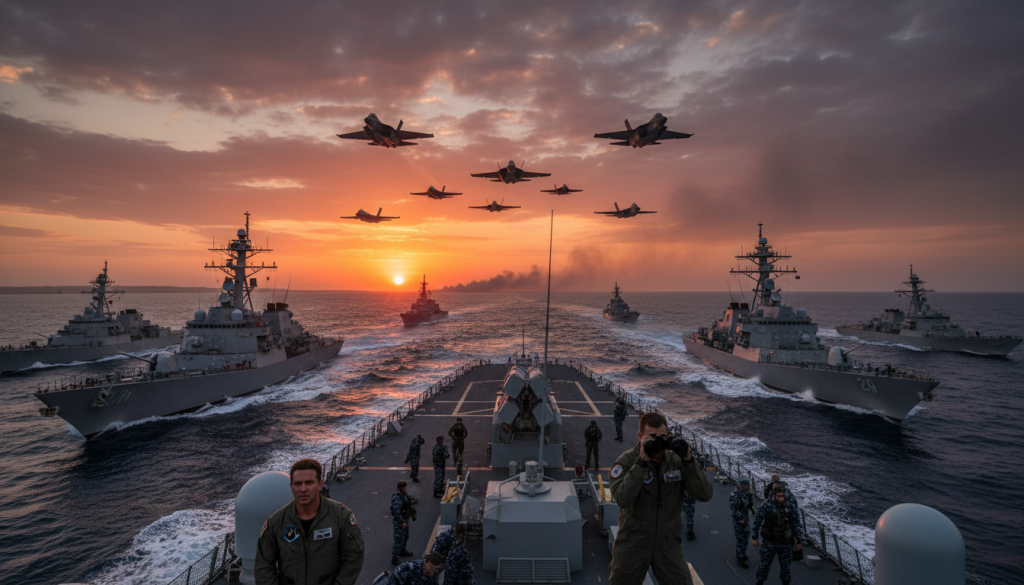
Trump’s deadline-driven threats and the “taken out” remarks are raising global alarm
President Donald Trump’s public threats have added heat to an already tense moment. He said Iran could be “taken out” in one night. He described “complete demolition… over a period of four hours.”
When asked about Geneva Convention issues tied to attacks on civilian infrastructure, he said “not at all.” Then he added, “I hope I don’t have to do it.”
The tone has drawn sharp pushback in U.S. media. There are calls to walk it back. One snapshot of the backlash is captured in Piers Morgan’s criticism. It shows how quickly words can harden positions and accelerate military escalation.
Iran’s stated conditions for a “lasting end” to war, including sanctions relief and reconstruction
Iran has laid out what it says would end the fighting for good. IRNA reported a 10-clause response. It includes an end to conflicts in the region, a protocol for safe passage through the Strait of Hormuz, lifting of sanctions, and reconstruction.
- Safe passage rules tied to Hormuz shipping lanes
- Lifting of sanctions as part of an end-state package
- Reconstruction commitments after damage to infrastructure
Those demands signal that Tehran is treating the crisis as a bargain over security and economics. This gap in end goals can widen into a broader global conflict when neither side sees a workable off-ramp.
The Strait of Hormuz as leverage: why a chokepoint tied to about a fifth of global oil and gas matters
The Strait of Hormuz is the pressure valve. It scares energy traders and defense planners. After the Feb. 28 U.S./Israel attack, Iran effectively closed Hormuz, a conduit for about a fifth of the world’s oil and natural gas supply.
When shipping risk rises, insurance costs climb, supply chains tighten, and navies move closer together. That is how a regional standoff can turn into military escalation with spillover effects far from the Gulf.
Legal and humanitarian warnings: ICRC concerns about threats to essential civilian infrastructure
Humanitarian law is another friction point. ICRC President Mirjana Spoljaric has warned that deliberate threats against essential civilian infrastructure are illegal. Attacks on power, water, and bridges can affect families long after a strike ends.
In parallel, wider nuclear fears are amplified by great-power tensions and the fragility of arms control. Reporting like this, an overview of nuclear strike risk and possible targets, shows why the public keeps asking, again and again, could it become nuclear even when the flashpoint starts in one corridor of sea lanes.
With hard language, high-stakes shipping routes, and legal red lines all in play, the same anxious question hangs over the moment: are we heading to global war? Could it become nuclear as the fight pulls more actors toward a shared edge?
Diplomacy Under Pressure: Mediation, ceasefire proposals, and hardening positions
As the crisis grows, secret talks try to keep up with public deadlines and battles. Each attack raises tension, and each missed deadline makes war seem faster than peace.
Pakistan’s reported mediator role and the proposed ceasefire-to-settlement framework
A U.S. plan, passed through Pakistan, calls for an immediate ceasefire followed by quick talks. It aims for a deal in 15 to 20 days. This is a tight timeline in a world where trust is hard to find.
Pakistan’s army chief, Field Marshal Asim Munir, spoke with U.S. officials all night. They wanted to ease tensions before the war sped up.
Tehran’s reported rejection of a temporary ceasefire in favor of a permanent end to the war
Tehran turned down a short ceasefire, saying they want a lasting peace. This makes it harder to find short breaks in the crisis, even when people are at risk.
Foreign Ministry spokesperson Esmaeil Baghaei said Tehran’s demands are firm. He called U.S. proposals, like a “15-point plan,” too much. This keeps tensions high as diplomats try to find a way out.
How stalled negotiations can intensify international crisis dynamics
When talks stall, deadlines get tighter, and each side shows strength in public. This can make the crisis worse because war seems faster than peace.
The conflict keeps moving: the U.S. and Israel attack Iran, and Iran fires missiles and drones. Those following the ceasefire news see how politics and war compete for attention.
Regional Spillover and the Risk of Wider World War Scenarios
Local fights often spread beyond their borders. Geography, supply routes, and security agreements can turn a small conflict into a global crisis. This is true, even when energy and nuclear safety are involved.
Strikes and counterstrikes expanding beyond borders
As fights escalate, nearby countries can get involved. This can happen through airspace, basing rights, and border security. Iranian strikes in neighboring areas show how quickly conflicts can grow.
Leaders make urgent decisions in these situations. This can lead to a global conflict. Planning leaks and public warnings also influence actions, even when details are disputed.
One example of this is leaked World War plans. They show the real risk of escalation, not just as a theory.
Energy facilities and neighboring states
Energy sites are not just targets; they are signals. Attacks on key energy facilities in Qatar and Saudi Arabia show how fast fear can spread. A supply shock can raise fuel costs and strain shipping insurance.
The Strait of Hormuz is critical because it carries a fifth of global oil and gas. Iran’s actions after the late-February attacks can disrupt global markets. This can lead to economic ripple effects and raise fears of nuclear war.
Signals from military-to-military ties
Readiness signals often appear outside the immediate battle area. A reported two-week Egypt–Pakistan exercise is an example. Such drills suggest contingency planning when regional security is fragile.
- Interoperability training can shorten response times if a crisis spreads.
- Shared tactics and logistics can change how neighbors read deterrence signals.
- Publicized exercises can harden expectations that a global conflict could widen.
Global institutions and nuclear safety anxieties
Nuclear-adjacent incidents add urgency. Rafael Grossi’s warning about strikes near an Iranian nuclear power plant is an example. Such incidents can magnify escalation dynamics and keep nuclear war fears alive.
These worries strain diplomacy. Inspectors, humanitarian groups, and allies may push for new limits. Military planners focus on advantage. This creates a cycle of threats, alerts, and countermeasures that resembles a world war atmosphere.
Economics, Influence, and Information Power in a Global Conflict
Today, many Americans wonder: Are we heading to global war? The concern isn’t just about missiles and troops. It’s also about money, who owns what, and the stories we hear during crises.
When tensions rise, things can move quickly. Investors watch energy prices and news closely. This creates a power struggle, even when talks are ongoing.
Gulf wealth funds and exposure
Gulf sovereign wealth funds are close to the heart of Middle East issues. Attacks on energy sites in Qatar and Saudi Arabia can affect shipping and insurance. This is important in a crisis, when markets try to price uncertainty quickly.
Even simple investment choices seem strategic when tensions are high. The question of global war is discussed in earnings calls and trading rooms, not just speeches.
Capital flows as political risk signals
News about David Ellison‘s company, Skydance, shows how money follows headlines. Almost $24 billion from Gulf funds is part of an $81 billion deal. This happens as the U.S. and Israel’s war with Iran raises concerns, adding to the crisis.
- Saudi Arabia’s Public Investment Fund: roughly $10 billion
- Additional equity commitments: Qatar Investment Authority and Abu Dhabi’s L’imad Holding Co.
- Backers also cited: Larry Ellison and RedBird Capital, led by Gerry Cardinale
Deals can absorb fear, as shown by the terms. There’s $54 billion in debt commitments from big banks. The deal’s total value is $110 billion, including debt. There’s also a $2.8 billion termination fee for Netflix and a $650 million quarterly fee for WBD shareholders.
Regulators as a second battlefield
In the U.S., CFIUS and the FCC will scrutinize the deal. Europe is seen as even tougher. Omeed Assefi, the acting head of the DOJ Antitrust Division, says the deal won’t be rushed for political reasons. This process can become a battleground for influence and delay during tense times.
The deal’s structure aims to reduce controversy. Gulf funds will have non-voting shares and no board seats. Yet, the question of global war is always on people’s minds, making even routine steps feel charged.
Information power and consolidation
Who owns the media shapes what we see and believe. A merged entity would include HBO, CNN, CBS, “Harry Potter,” and “The Godfather.” This can influence how we see crisis coverage.
Consolidation is a key part of the story, not just a business detail. When tensions rise, stories spread faster than corrections. For viewers, the question of global war can feel like a media product as much as a strategic issue.
Conclusion
The question of whether we’re heading to global war is always on our minds. Events are moving too fast for talks to keep up. When threats and strikes happen together, diplomacy often falls behind.
Each new attack seems to bring us closer to a bigger conflict. This pattern makes us wonder if we’re on the path to war.
Recent events show us the reality of escalation. Donald Trump’s words about taking out targets “tomorrow night” added to the tension. There have been U.S. and Israeli attacks, and Iran has fired missiles and drones.
Iran wants a permanent end to war, but has a 10-point plan. This includes getting sanctions lifted and rebuilding.
Energy issues make things even more serious. The Strait of Hormuz is key to a fifth of the world’s oil and gas. If there’s trouble there, oil prices could go up, leading to more military action.
Also, if there are attacks near nuclear sites, the risk of nuclear war grows. This is a big worry for leaders around the world.
In the U.S., the question of war is not just about military actions. It’s also about diplomacy, key points, power, and media. Russia’s Oreshnik missile warning shows how fast things can get out of hand. New systems and less strict nuclear rules make it harder to control the risks once things start moving.